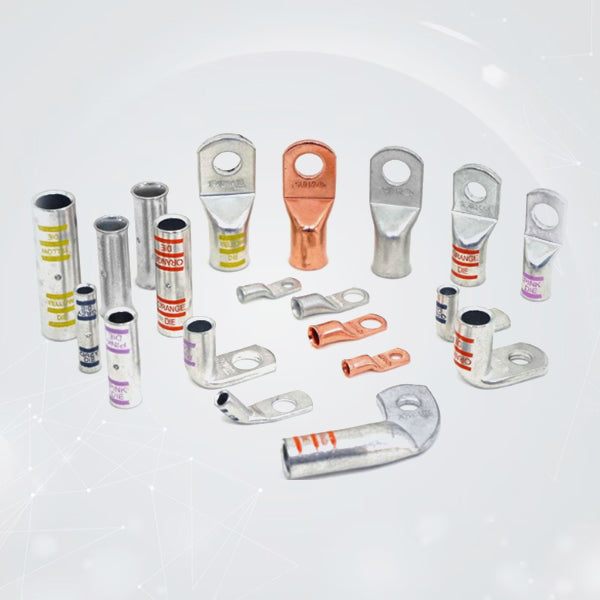


90 Degree Battery Terminal for High-Amperage Battery Connections
Tight engine bays, cramped RV compartments, marine battery boxes with zero clearance — straight lugs don't cut it in these builds. That's where a quality 90 degree battery terminal solves the problem fast.
When Straight Lugs Create the Problem
Most battery terminals are designed for open, clean installs. But real-world builds don't work that way.
Seen it: a 4/0 AWG cable forced into a straight lug in a boat battery compartment, bent hard against the lid. Six months later, the conductor work-hardened right at the barrel, cracked the insulation, and started arcing. Straight lugs in tight spaces create a bend stress point. Cable flexes, strands fatigue, resistance climbs. A 90 degree battery terminal eliminates that bend at the connection — the angle is built into the lug, not forced into the cable.
What the 90-Degree Angle Actually Does
The geometry here is simple physics. Copper doesn't like being bent past its minimum bend radius, especially at high gauge.
When a straight lug forces a cable to turn 90 degrees past the terminal post, the cable becomes the bend. Every vibration — diesel engine, road bounce, wave chop — cycles stress into that same spot. A 90 degree battery cable end puts the angle in the lug barrel itself, so the cable runs straight out, no stress concentration, no fatigue point. Conductors stay fully seated in the barrel. Contact area stays maximized. Resistance stays low.
High-Amperage Loads Demand Clean Connections
Low-resistance connections aren't just about efficiency. At 200A, 300A, even 400A draw, a bad terminal gets hot fast.
- A 10 milliohm resistance at 200A generates 400 watts of heat at the joint
- Heat accelerates oxidation, oxidation increases resistance, and it spirals from there
- Most connection failures in high-amperage systems trace back to poor mechanical contact, not the cable itself
A properly crimped 90 degree battery terminal adapter— hex die, full compression, no voids — keeps contact resistance near zero. That's the difference between a connection that runs cool for a decade and one that melts a terminal cover in year two.
Sizing Matters: Match the Lug to the Cable
Don't guess on gauge-to-barrel fit. Undersized barrels compress poorly. Oversized barrels leave air gaps.
Selterm's 90 degree bent lugs come in sizes covering 2 AWG through 4/0 AWG, with stud holes from 5/16 to 1/2 inch. For a 4/0 x 3/8 inch application — common on lithium battery banks and inverter installs — the barrel needs to fully capture all conductors with no stray strands. Truth? A single strand folded outside the barrel kills the pull strength and concentrates heat. Size it right, crimp it clean.
RV and Inverter Builds: Where These Shine
RV battery bays are notorious for vertical battery posts sitting six inches from a structural crossmember. There's no room to run a straight cable up and over.
Pro tip: a 90 degree battery cable end lets the cable exit horizontally right off the post, routing neatly along the battery tray without looping over the top. Same goes for inverter terminals mounted flush against a cabinet wall. The lug takes the angle, the cable takes the straight run. Cleaner install, less stress on the conductor, easier inspection later. Seen this setup cut install time in half on back-to-back RV solar jobs.
Marine Applications: Tinned Copper Is Non-Negotiable
Salt air and bare copper don't coexist. Oxidation starts within weeks on an unprotected barrel in a bilge environment.
- Use tinned copper lugs in any marine install
- Tin coating blocks galvanic corrosion at the copper-to-stud contact
- Pair with adhesive-lined heat shrink for full moisture seal
- Inspect terminals annually — marine vibration loosens connections over time
Selterm's 90 degree battery lugs are available in tinned copper, purpose-built for this environment. A tinned barrel in a properly crimped, heat-shrunk connection will outlast the boat wiring it's attached to.
Crimping Right: No Shortcuts at High Amperage
Hammer-type crimpers have no place on high-amperage lugs. Seen failed pulls where the cable spun right off a poorly crimped 2/0 lug — conductor barely indented the barrel.
Use a hex die ratchet crimper sized to the AWG. The die should close completely with audible click, full compression, uniform hex pattern on the barrel. After crimping, do a pull test — grip the cable, pull hard. A proper crimp doesn't move. If the barrel rotates or the cable shifts, recrimp. No shortcuts on a 90 degree battery cable end carrying 200A continuous.
Heat Shrink Finish: Seal It and Forget It
Adhesive-lined heat shrink is the right finish on every terminal, angled or straight.
Standard PVC tape? Year one, the jacket splits at the terminal entry, moisture wicks in, and corrosion starts. Adhesive-lined heat shrink shrinks down, the purple glue oozes out the ends, and that connection is sealed against moisture, vibration, and UV. Apply it before the heat gun cools — full shrink, full adhesive flow. A properly sealed 90 degree battery terminal in an RV build should look the same at year five as it did at install.
No-BS Wrap
Tight installs need the right hardware. A 2/0 90 degree lug solves the bend stress problem that kills straight lugs in cramped battery bays, engine compartments, and marine boxes. Properly sized 90 degree battery cable ends — tinned copper, hex-crimped, heat-shrunk — deliver the connection integrity that high-amperage loads demand. Selterm's lineup handles this clean, with options across gauge ranges and stud sizes built for real installs, not showroom demos.