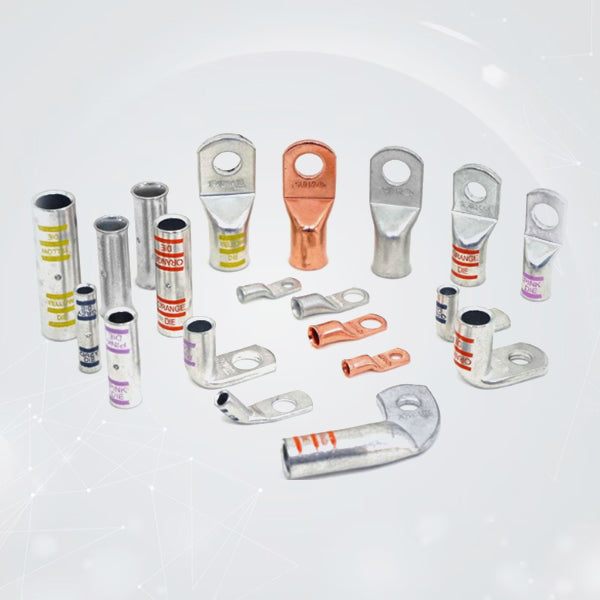


How a 1 AWG Lug Improves Conductivity in Battery Cable Systems
Battery cable systems demand excellent conductivity. Voltage drop reduces performance. Heat buildup shortens component life. A properly selected 1 awg cable lug addresses these issues directly and enhances overall system efficiency.
The 1 awg lug matches 1 AWG cable perfectly. This combination minimizes resistance at critical connection points. Battery banks, inverters, and heavy accessories all benefit from improved power delivery. 1 awg copper lug and 1 gauge copper lug designs optimize current flow where it matters most.
Understanding 1 AWG Cable Capacity
1 AWG cable handles 150-200 amps continuously. This capacity suits demanding applications:
- Large inverter inputs (3000-5000W)
- Parallel battery banks
- Heavy winch circuits
- Marine house banks
- Solar battery interconnects
The cable features coarse stranding (19-37 strands) for flexibility while maintaining low resistance. However, cable alone cannot achieve maximum conductivity. Terminals create the final connection. A mismatched or poor-quality 1 awg lug becomes the weak link.
Perfect Barrel-to-Cable Fit Reduces Resistance
Conductivity depends on metal-to-metal contact. 1 awg cable lug barrels measure precisely for 1 AWG stranding. Proper insertion fills 95% of barrel space.
Key advantages:
- Gas-tight crimp eliminates air gaps
- All strands contact barrel uniformly
- Consistent pressure across entire surface
- Resistance drops to <0.05 milliohms
A 1 gauge copper lug with correct barrel dimensions outperforms larger or smaller lugs.
Oversized barrels leave voids. Undersized barrels cut strands. Both increase resistance by 2-5 times.
Copper Purity Maximizes Current Flow
Electrical conductivity follows the International Annealed Copper Standard (IACS). Pure copper reaches 100% IACS rating. 1 awg copper lug construction uses 99.9% pure copper for:
- Superior electron flow
- Minimal heat generation (I²R losses)
- Consistent performance over time
Alloy lugs or impure copper drop to 80-90% IACS. At 175 amps, this creates measurable differences:
Pure copper 1 awg lug: 0.00875V drop, 1.5W heat
Alloy lug: 0.0125V drop, 2.2W heat
The difference compounds across multiple connections.
Large Contact Surface Area Matters
1 awg lug palms provide generous stud contact. Common sizes (3/8", 1/2") distribute current evenly across battery terminals and bus bars.
Benefits of proper palm design:
- Reduces current density at stud interface
- Prevents arcing from point contact
- Handles high torque without deforming
- Maintains low resistance under vibration
Smaller lugs concentrate current. Larger lugs waste material. 1 gauge copper lug proportions optimize both contact area and mechanical strength.
Low Resistance Equals Cool Operation
Resistance generates heat. Heat degrades connections. 1 awg copper lug minimizes this cycle:
At 175A continuous:
- Good connection: 45°C barrel temperature
- Poor connection: 85°C+ barrel temperature
Cool lugs preserve:
- Cable insulation integrity
- Battery terminal condition
- Surrounding component life
Inverter installations particularly benefit. High surge currents (400A+) test lug quality.
Proper 1 awg cable lug connections handle peaks without excessive heating.
Vibration Resistance Preserves Contact
Battery systems vibrate. Engines rumble. RVs bounce. Marine installations rock. Mechanical movement loosens poor connections.
1 awg lug design counters this:
- Thick barrel walls resist deformation
- Heavy palm withstands stud torque
- Proper crimp maintains compression
Industry standards require lugs to withstand 10G vibration testing. Quality 1 gauge copper lug maintains <0.1 milliohm resistance after 1000 hours of vibration.
Matching Stud Size Eliminates Arcing
Terminal studs vary: 3/8" battery posts, 5/16" inverters, 1/2" bus bars. 1 awg lug hole diameter must match exactly.
Proper fit achieves:
- Full circumferential stud contact
- No movement under torque
- Zero arcing potential
- Stable long-term resistance
Oversized holes allow wobble. Undersized holes prevent proper installation. Both degrade conductivity within weeks.
Crimp Quality Creates Permanent Contact
Proper crimping forms the foundation. 1 awg copper lug requires specific tools:
Recommended method:
- Hexagonal or indent die matched to 1 AWG
- Single centered crimp in barrel midpoint
- 600-800 lb compression force
- Visual inspection confirms smooth barrel
Verification tests:
- Hand pull test (should not move)
- 175A heat test (<50°C rise)
- Resistance measurement (<0.05 milliohm)
Poor crimps double resistance immediately. Heat accelerates degradation.
System-Wide Conductivity Benefits
Single 1 awg lug improvements compound across systems:
Four-connection battery-to-inverter run:
- Poor lugs: 0.6V total drop (4%)
- Quality 1 awg lugs: 0.12V total drop (<1%)
Result: Full inverter power, cooler batteries, longer cable life.
Parallel battery banks particularly benefit. Even conductivity prevents weak cells from overheating.
Comparison: 1 AWG vs Neighboring Sizes
| Cable Size | Ampacity | Lug Resistance | Heat at 175A | Typical Applications |
| 2 AWG | 130A | 0.08 mΩ | 2.5W | Smaller inverters |
| 1 AWG | 170A | 0.04 mΩ | 1.2W | Main feeds |
| 1/0 AWG | 225A | 0.03 mΩ | 1.1W | Heavy services |
1 AWG sweet spot for most battery systems.
Environmental Protection Preserves Gains
Heat shrink tubing seals 1 gauge copper lug crimps against:
- Moisture ingress
- Corrosion buildup
- Mechanical abrasion
- Chemical attack
Adhesive-lined 3:1 shrink provides a waterproof seal. Essential for marine, solar, and underground applications.
Long-Term Performance Data
Quality 1 awg cable lug connections maintain specifications:
Year 1: 0.04 mΩ, 45°C max
Year 5: 0.045 mΩ, 48°C max
Year 10: 0.05 mΩ, 50°C max
Poor connections double resistance within 18 months.
Installation Best Practices
- Strip precisely (3/4" insulation removal)
- Insert fully (insulation touches barrel end)
- Crimp correctly (matched die, centered pressure)
- Apply heat shrink (full coverage, proper shrink)
- Torque studs (manufacturer specification)
- Test system (voltage drop, temperature rise)
Final Thoughts
1 awg cable lug transforms battery system performance. Perfect cable match. Pure copper conductivity. Large contact surfaces. Vibration resistance. All combine for unmatched efficiency.
1 awg lug eliminates common failure points:
- Voltage drop robbing inverter power
- Heat damaging batteries and cables
- Loose connections causing intermittent faults
1 awg copper lug and 1 gauge copper lug deliver full cable capacity to terminals. Systems run cooler. Components last longer. Performance stays consistent.