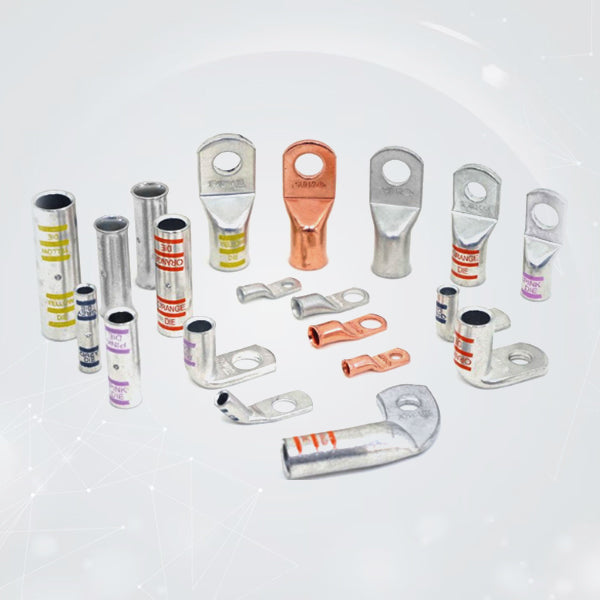


Using 8 Gauge Lugs for Winch and Trolling Motor Wiring
Picture this.
You're forty minutes offshore, early morning, fish are active, and your trolling motor starts cutting out. Not dead, just stuttering. Full thrust one second, nothing the next. You check the battery. Charged. You check the wiring. Looks fine.
What you can't see is what's actually causing the problem.
Somewhere along that cable run, almost certainly at one of the terminal ends, there's a weak connection quietly choking the power before it ever reaches the motor. The cable is doing its job. The battery is doing its job. But that little metal sleeve crimped onto the end of your wire? That's where the whole thing is falling apart. 8 gauge lugs may be a small part of the setup, but when they're carrying serious current, the quality of that connection matters far more than most people realise.
It's one of the most common and most overlooked problems in marine and off-road electrical setups. And the fix is simpler than most people expect.
Why the Terminal End Matters More Than People Think
When someone rigs a trolling motor or wires up a recovery winch, the focus naturally goes to the big stuff. The motor thrust rating. The battery capacity. The wire gauge running through the hull or along the frame.
All of that matters. But every bit of power from that battery has to pass through the terminal connector at the end of the cable to reach the motor or winch. If that connector is undersized, made from the wrong material, or just plain cheap — it doesn't matter how good everything else in the circuit is.
The terminal end is the last handoff. And a bad handoff loses power, generates heat, and eventually fails — usually at the worst possible moment.
What Makes 8 AWG the Right Choice for This Job
Cable sizing in electrical work comes down to how much current a wire can safely carry. Thicker wire carries more current without getting hot.
8 AWG sits in a specific and important range. It's significantly thicker than the wiring used for basic accessories like lights or a radio. That extra thickness is what makes it the standard choice for equipment that pulls continuous, heavy power — things like:
-
Trolling motors in the 30 to 55 pound thrust range that run for hours at a time
-
Utility and UTV winches in the 2,500 to 4,500 pound range that pull big bursts of power during a recovery
-
Marine fuse blocks and sub-panels that distribute power to multiple onboard systems
-
Off-grid solar charge controllers managing power flow between panels and battery banks
These aren't accessories. They're the main event. And they draw real current — typically 40 to 60 amps or more — for extended periods.
That level of current demand is exactly why the terminal connection matters so much. A connector that would hold up fine on a light-duty circuit becomes a genuine problem when you're pushing that kind of load through it continuously.
What Happens When the Connector Can't Keep Up
When a weak terminal has to carry more current than it was built for, it creates resistance. Think of resistance like a partial blockage in a garden hose — the water still gets through, but not freely. Pressure builds behind the blockage and energy is wasted.
In an electrical circuit, that wasted energy doesn't just disappear. It turns into heat. And that heat creates a chain of problems that gets worse over time.
The motor or winch loses power even though the battery is fine. Current can't move freely through the connector, so the voltage drops before it reaches your equipment. Your trolling motor loses thrust. Your winch strains under a load it should handle easily. The battery monitor shows plenty of charge, but the equipment is starved of power.
The connection point gets dangerously hot. A connector fighting to carry current it wasn't designed for can reach temperatures well over 180 degrees. At that heat, wire insulation softens and melts. The plastic terminal covers the warp. In a boat bilge or under a truck hood — environments already dealing with moisture and fuel — that's a serious safety problem.
The connection works itself loose. Every time the connector heats up and cools back down, the metal expands and contracts slightly. Over dozens of cycles, this movement loosens the crimp joint. Loose high-current connections arc and spark intermittently — which is how you end up with a trolling motor that cuts in and out randomly, or a winch that hesitates mid-pull.
Why Pure Copper Is the Only Material Worth Using
When you start shopping for 8 AWG wire lugs, you'll find them made from all kinds of materials. Brass. Aluminum. Various alloys. Pure copper.
Here's the straightforward version of why it matters.
Copper conducts electricity better than virtually any other affordable metal. Aluminum carries about 60% as much current as copper for the same connector size. Brass — which is what a lot of cheap connectors are made from — carries less than 30%.
That last number is the one that should concern you. If you run a quality 8 AWG copper cable from your battery and terminate it with a brass lug, you've forced the electricity through a connector that handles less than a third of the power your cable was designed to carry. You built a capable highway and merged it into a single-lane side street right at the finish line.
8 AWG copper lugs eliminate that problem entirely. Copper to copper, the connection carries the full rated current of your cable without any restriction at the terminal.
There's a second reason copper matters that most people don't consider until something goes wrong.
Metal expands when it gets warm and contracts when it cools. In a trolling motor circuit running hard for several hours and then sitting overnight, your wiring goes through that cycle constantly. When your cable and your connector are both pure copper, they expand and contract at the same rate. The connection stays tight.
Mix metals — aluminum connector over copper wire, for example — and those two materials move at different rates. Over time, small gaps open up inside the crimp barrel. Air gets in. Corrosion starts. Resistance climbs. The connection heats up faster and faster until it fails.
Stick with 8 awg copper lug options made from pure copper, and that whole sequence of events simply doesn't happen.
The Difference Between Cheap Connectors and Ones Built for This
Not all copper connectors are created equal, and this is where a lot of well-intentioned builds go wrong.
The connectors hanging on the pegboard at most auto parts stores are made by taking a thin flat sheet of copper, stamping it into shape, and folding it into a barrel. Look at one closely and you can see the seam running down the side where the edges meet.
Those connectors were engineered for automotive electrical accessories — things that pull a small amount of current for short periods. They work perfectly fine for adding a set of running lights or wiring a small relay.
But put one on a trolling motor circuit running at 50 amps for three hours, or on a winch pulling hard against a stuck truck, and the story changes fast. The thin walls can't sustain that kind of load. When you try to crimp them with enough force to make a solid connection, the seam can split. The result is a connection that looks fine from the outside but has a gap inside the barrel — a gap that becomes a resistance point, a heat source, and eventually a failure.
Heavy-duty 8 gauge lugs start life as a completely different product. They're cold-forged from solid, thick-walled copper tubing — no seams, no folded edges, no weak points. When you compress one with a proper crimping tool, the walls collapse evenly around the wire strands and the whole assembly fuses into essentially one solid piece of copper. Nothing to split, nothing to work loose, nothing to fail.
Quality 8 gauge wire lugs also have a closed end — the back of the barrel is sealed. Once your cable is crimped in place, the copper strands inside are completely isolated from the outside world. Boat bilges, splash zones, muddy trails, salt air — none of it can reach the wire. Open-ended connectors leave the wire strands exposed at the back, and in a marine or off-road environment, that means green corroded copper within a season or two.
Why Marine and Off-Road Builds Specifically Need Better Connectors
A trolling motor and a winch have something in common that most automotive accessories don't — they both operate in genuinely brutal environments while pulling sustained heavy current.
A trolling motor sits at the bow of a boat, gets splashed constantly, runs for hours at a time, and experiences vibration every time you hit a wave. A recovery winch bolts to the front of a truck that goes off-road — through mud, water crossings, rocks, and rough terrain.
Cheap connectors in these environments don't gradually degrade. They fail quickly and at the worst times.
The closed-end, seamless design of a quality heavy-duty lug addresses every specific challenge these environments create:
Moisture and salt air can't get into the barrel to corrode the wire strands inside. The thick, flat mounting pad creates full metal-to-metal contact at the terminal post, so current moves freely without restriction. The reinforced point where the barrel meets the ring eyelet handles continuous vibration without cracking — which is a real failure point on thin stamped connectors that see a lot of mechanical movement.
How to Install Them So They Actually Last
A quality lug installed badly will still underperform. Here's what actually matters during installation.
Get the size right. Your cable needs to be true 8 AWG, and your lug needs to match. Strip just enough insulation to fill the barrel — not more, not less. Never trim wire strands to make a smaller lug fit. You're removing current-carrying copper right at the point where it matters most.
Use a proper crimping tool. Pliers don't work. Hammer punch crimpers are better than nothing but still leave air gaps inside the barrel. A hydraulic hex crimper applies force from multiple sides at once and fuses the connector and wire into a single solid mass. For any build that's going to see real load, it's the right tool for the job.
Seal with dual-wall heat shrink. Standard heat shrink tubing just covers the connection — it doesn't really protect it. Dual-wall heat shrink has an adhesive layer built in. When you apply heat, that adhesive melts and flows out from both ends of the tube, creating a fully waterproof seal around the back of the lug. In a marine environment especially, this step isn't optional.
Tighten the bolts properly. Hand-tight is not tight enough — but overtightening strips the threads on battery studs and terminal posts. Use a wrench and follow the torque specs for your specific terminals. It takes a couple of extra minutes and prevents a frustrating and expensive problem.
Build It Once, Build It Right
Whether you're setting up a trolling motor for a season on the lake or rigging a winch for serious off-road use, your electrical system is only as reliable as every connection in it.
The terminal at the end of your cable is the last point where you have control over how cleanly power reaches your equipment. Quality 8 AWG wire lugs made from solid copper, properly crimped and sealed, give you a connection that carries full power without heat, without resistance, and without the kind of slow degradation that turns a working setup into a frustrating one.
The motors and winches get all the attention. The connectors do all the work.
Get the connectors right, and everything else performs the way it's supposed to.
Shop SELTERM 8 AWG bare copper lugs — available in multiple stud sizes and pack quantities at selterm.com/collections/8-awg-bare-copper-lugs-battery-cable-ends