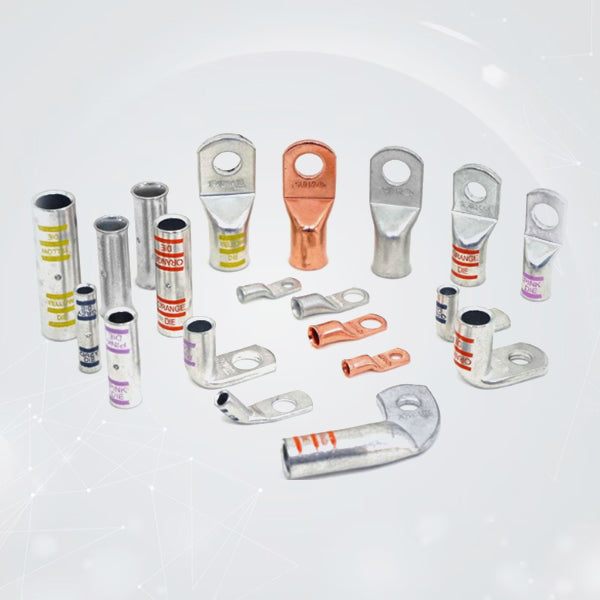


Why Heavy-Duty Copper Battery Lugs Are Essential for Off-Grid Solar Systems
You spent weeks planning it, researched every panel brand, compared battery options until your eyes glazed over.
Picked an inverter that could power a small house. Wired everything up, stood back, and felt genuinely proud of what you built.
Then you turned on your microwave.
The inverter alarm went off. You checked the battery — nearly full. Confused, you reached down toward the wiring and pulled your hand back fast. A tiny metal piece connecting your cable to the battery was hot enough to burn you.
That little copper battery lugs connection had just become the weakest point in a system worth thousands.
And it just took your whole system down.
Nobody Talks About the Connectors
When people build off-grid solar setups — for cabins, RVs, vans, workshops, you name it — they spend serious time and money on the big pieces. The panels. The batteries. The inverter.
Then they grab whatever bag of wire connectors is cheapest and move on.
It seems logical. How much could a little metal connector really matter?
A lot, it turns out.
Every single bit of power your solar panels collect and your battery store has to pass through those connectors to reach your lights, your fridge, your inverter — everything. If the connector is weak, it doesn't matter how good everything else is. The whole system gets strangled at that tiny point.
That's why builders who've been down this road once — and learned the hard way — come back to the same answer every time: heavy duty battery lugs made from pure copper. Not the cheapest thing they could find. The right thing.
Why Off-Grid Power Is Harder on Connectors Than You'd Think
Here's something worth understanding — and don't worry, this isn't going to get complicated.
The power in your house runs at a relatively high voltage — 120 volts. Because the voltage is high, it doesn't need to push a lot of current to move power around. Think of it like water flowing through a pipe under high pressure — you don't need a huge pipe to move a lot of water.
A battery bank works differently. It runs at much lower voltage — usually 12, 24, or 48 volts. To move the same amount of power at lower pressure, you need a much bigger "pipe." In electrical terms, that means way more current — measured in amps — flowing through your cables and connectors.
Here's what that looks like in real numbers. A standard microwave running off a 12-volt battery pulls over 100 amps through your wiring. A large inverter running near full power can push 250 amps or more.
That's an enormous amount of electricity flowing through what is essentially a small metal sleeve at the end of your cable.
When a weak connector has to handle that much current, it creates friction — and that friction becomes heat. And heat causes three things that you really don't want happening inside your van or cabin:
Your system shuts off even though the battery shows plenty of charge. The power can't get through the connector fast enough, so the voltage drops and your inverter thinks the battery is dead. It's not — the connector is just choking it.
Things start getting hot that shouldn't be hot. A struggling connector can reach well over 200 degrees. That melts wire insulation, damages battery terminals, and turns what should be a reliable system into a fire hazard.
Connections work themselves loose over time. As the connector heats up and cools down over and over, the metal expands and contracts. Bolts loosen. And a loose connection carrying that much current can arc and spark.
None of this is hypothetical. It happens to DIY builders all the time — usually after they've spent thousands on everything else.
Why Pure Copper Is the Right Material
Walk into any hardware store and you'll find connectors made from all kinds of metals — brass, aluminum, and various alloys that sound impressive on the packaging.
Here's the simple truth: battery copper lugs made from pure copper are what you want for moving heavy amounts of power from a battery bank. It's not even close.
Copper conducts electricity better than almost any other common metal. Aluminum carries about 60% as much power as copper for the same size connector. Brass — which shows up in a lot of cheap connectors — carries less than 30%.
Picture a six-lane highway that suddenly narrows down to a single dirt road for a stretch, then opens back up again. That's what happens when you run high-grade copper cable and terminate it with a brass connector. You've built a bottleneck right where you can least afford one.
There's another reason to stick with copper on copper — and this one surprises people.
Metal expands when it heats up and shrinks when it cools down. Every time you run your inverter and then turn it off, your cables and connectors go through that cycle. If your cable and your connector are both made from copper, they expand and contract at the same rate. They move together. The connection stays tight.
Mix metals — say, an aluminum connector crimped onto a copper cable — and they expand and contract at different speeds. Over time, tiny gaps open up inside the connector. Air gets in. The copper starts to corrode. Resistance builds. The connection gets hotter with every use until eventually something fails.
When people ask what type of lug they should buy, the answer is always the same: battery copper lugs made from solid, pure annealed copper. Everything else is a compromise.
Not All Copper Connectors Are Equal
This is where a lot of people get caught out — they buy copper connectors and assume that's enough.
The connectors you'll find at most auto parts stores are made by taking a thin sheet of copper, stamping it into shape, and folding it into a tube. If you look at the barrel, you can see the seam where the edges meet.
Those connectors were designed for one very specific job: starting a car. The starter motor pulls a big burst of power for two or three seconds, the engine starts, and that's it. The connector never has to sustain anything. It never really gets hot.
An off-grid solar system is a completely different situation. Your inverter might run for two or three hours at high power while you cook dinner, run a power tool, or watch TV. Under that kind of sustained load, cheap stamped connectors fail. The thin walls can't take the heat. When you try to crimp them, the seam can split.
Heavy duty battery lugs are built differently from the start. They begin as solid, thick-walled copper tubing — no seams, no folded edges. When you crimp them properly, the copper collapses evenly around the wire and creates what's essentially one solid piece of metal. No air gaps. No weak spots. No seam to split under pressure.
Quality lugs also feature a closed end — the back of the barrel is sealed. Once your cable is crimped in, the copper strands inside are completely protected. Humidity, salt air, condensation — none of it can reach the wire. Open-ended connectors leave the wire exposed, and in a van, boat, or outdoor cabin, that means corroded green wire strands within a year or two.
That sealed, closed-end design is one of the things that separates a connector built for real-world use from one that's just built to look the part on a shelf.
The Case for Bare Copper Ring Terminals
You'll come across tinned copper lugs in your research — they have a shiny silver coating over the copper, and they're the right call for marine environments where salt air is constantly attacking your connections.
But for off-grid solar builds in cabins, sheds, RVs, and workshops, bare copper ring terminals are often the better choice.
Here's why. The tin coating on plated connectors, while great for fighting corrosion in wet environments, can actually cause a problem in high-temperature situations — it can develop tiny surface irregularities under sustained heat and pressure. Bare copper doesn't have that issue. It handles continuous high current without any interference from a coating.
Ring terminals also make a cleaner, tighter crimp. When the hydraulic tool compresses the barrel, there's nothing between the copper strands of your cable and the copper walls of the lug. Metal to metal, fully fused, with almost no resistance at the joint.
For any system where you're running serious loads for extended periods — exactly what an off-grid solar setup does every single day gives you the most direct, low-resistance connection possible. That translates to more power reaching your appliances, less heat in your wiring, and a system that performs the way you designed it to perform.
Getting the Installation Right
Even the best connector won't perform well if it's put in carelessly. Here's what actually matters when you're installing battery cable lugs.
Match the size exactly. Every connector is rated for a specific cable size — called the gauge. A connector for 2/0 gauge cable should go on 2/0 gauge cable. Don't trim wire strands to force a smaller connector to fit. You're removing current-carrying copper right at the most important point in the circuit.
Use the right crimping tool. Those punch-style hammer crimpers from the hardware store are better than using pliers, but they don't compress the connector evenly. A hydraulic crimping tool squeezes from multiple sides at once and applies enough force to essentially fuse the wire strands and connector into a single solid piece. If you're building a serious off-grid system, it's worth the investment.
Seal it properly. Regular heat shrink tubing just covers the connection. What you want is dual-wall heat shrink — it has a layer of adhesive built into it. When you apply heat, that adhesive melts and flows out from both ends, creating a completely waterproof seal. Road vibration, moisture, temperature swings — none of it gets through.
Tighten the bolts to the right amount. Hand-tight isn't tight enough — and too tight strips the threads on your battery posts. Use a torque wrench and follow the recommended spec for your battery terminals. It takes two extra minutes and saves you from expensive problems down the road.
The Bottom Line
Connectors aren't the exciting part of a solar build. Nobody films an unboxing video about battery lugs. They don't show up in anyone's thumbnail.
But they are the point where everything either works or it doesn't.
Every amp your panels pull from the sun, every kilowatt-hour your batteries store, every time you flip a switch — it all passes through those connectors. Cheap ones create heat, waste power, and eventually fail. Quality heavy duty battery lugs and bare copper ring terminals, properly crimped and sealed, give your system the clean, reliable path it needs to actually deliver what you built it for.
They cost a little more than the bargain alternatives. But when you're running an off-grid system you depend on — for your weekend cabin, your full-time van, your remote workshop — the right connectors aren't an upgrade.
They're just what a properly built system needs.
Get them right, and you'll never think about them again.
Get them wrong, and they'll be all you think about.
Shop SELTERM bare copper battery cable lugs — available in a full range of sizes at selterm.com/collections/bare-copper-battery-cable-lugs