

How to Choose the Right 90 Degree Lug for Your Application
Power systems demand reliable connections. Thick cables in tight spaces create real challenges. A straight lug often forces awkward bends that stress terminals and waste room. 90 degree lugs solve this problem cleanly. They build the angle right into the connector. This guide walks through every factor to pick the perfect 90 degree lug for automotive, marine, solar, or RV builds. Start with your needs and match specs step by step.
Step 1: Match Wire Size to Lug Barrel
Wire gauge sets the foundation. Always select a 90 degree lug barrel that fits your cable exactly. Too loose, and strands pull out. Too tight, and you nick copper during insertion.
Common sizes run from 8 AWG to 4/0. For example, 4 AWG cable needs a 1/4-inch inner diameter barrel. 2/0 takes 1/2-inch. Check the cable's circular mil area too. 4 AWG hits 21,000 cmil. Match that to lug specs for full strand contact.
Why precision matters shows in heat tests. A mismatched 90 degree battery lug on 2 AWG wire spikes resistance by 30 percent. Current turns to heat instead of power. Use this quick table for reference:
| Wire Size (AWG | Barrel ID (inches) | Typical Amps |
| 8 | 5/32 | 40-80 |
| 4 | 1/4 | 100-160 |
| 2/0 | 1/2 | 300-400 |
| 4/0 | 5/8 | 500+ |
Pro tip: Strip exactly 1/2 inch of insulation. Slide wire in until strands bottom out. An inspection hole confirms full insertion.
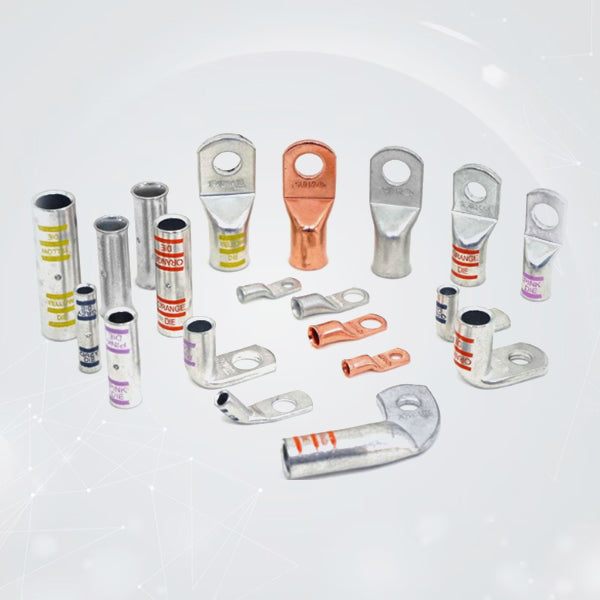
This 90 degree lug shows the classic bent design for 3/0 AWG wire. Note the clear barrel labeling and stud hole.
Step 2: Pick Stud Size and Terminal Type
Battery posts, bus bars, and inverters use specific studs. M6 (1/4-inch), M8 (5/16-inch), and M10 (3/8-inch) dominate. Measure your terminal first. A 90 degree battery terminal lug with a 3/8-inch hole fits most lithium battery tops.
Two-hole pads handle high torque on bus bars. Single-hole works for posts. Oversized holes slip under nuts. Undersized ones drill out the pad, thinning copper.
In solar banks, M10 studs link batteries side by side. A battery terminal 90 degree lug routes cable down without tower stacks. Match hole diameter to stud exactly for flat contact.
Step 3: Decide Bare Copper or Tinned Finish
Environment dictates plating. Bare copper 90 degree lugs deliver 100 percent IACS conductivity. They shine in dry garages or sealed boxes. No tin layer means zero added resistance.
Tinned 90 degree battery cable ends add a thin tin coat. It blocks oxidation in humid boats, salty air, or engine bays. Green corrosion kills connections over two years. Tin lasts 10 times longer in marine use.
Saltwater tests prove it. Bare lugs resist 200 amps initially but fail at 150 after exposure. Tinned 90 degree lugs hold steady. Choose tinned for outdoors. Stick bare for indoors.
Step 4: Factor in Ampacity and Duty Cycle
Current rules everything. Calculate continuous amps first. Add 25 percent safety margin. A 2000W inverter at 12V pulls 170 amps steady. Pick 90 degree battery lugs rated 200-250 amps.
Peak surges matter too. Winches hit 500 amps for seconds. 90 degree lugs with thick barrels handle bursts without sagging.
Long runs drop voltage. 4 AWG over 10 feet loses 0.3V at 100 amps. Shorten with 90 degree battery terminal routing. Always derate 15 percent for bundled cables or 105°F temps.
Step 5: Consider Bend Radius and Space Constraints
Not all 90 degree lugs bend the same. Tight 1-inch radii fit battery boxes. Wider 2-inch curves suit open engine bays.
Measure clearance from barrel exit to obstacle. Van builds cram dual batteries. A compact 90 degree lug drops cable 1.5 inches low. Straight lugs need 4 inches up first.
Factory bends beat DIY. Hammered lugs thin at curves. Precise tooling keeps walls uniform for cool crimps.
Step 6: Check Material and Certifications
C11000 electrolytic copper rules. It hits full conductivity without impurities. Avoid brass fakes labeled "copper plated." They heat twice as fast.
UL 486A listing confirms crimp strength. ABYC marine standards demand tinned finishes. Look for these stamps on quality 90 degree battery cable ends.
Wall thickness counts. 0.06-inch minimum on 2 AWG lugs spreads heat. Thin walls bow under 10-ton crimps.
Application-Specific Recommendations
Automotive and Off-Road
Winches and starters need 1/0 or 2/0 tinned 90 degree lugs. M8 holes fit alternator posts. Vibration-proof crimps hold over rough trails.
Marine Power
Tinned M10 90 degree battery terminals resist salt. Short barrels clear cowlings. Pair with 3:1 heat shrink for waterproof seals.
Solar and RV
4 AWG to 2/0 bare copper saves cost indoors. Stack batteries with battery terminal 90 degree lugs for neat bus links. M6 suits small inverters.
Car Audio
2 AWG 90 degree battery lugs route amps to trunks. Low profiles avoid box interference.
Real build example: A Jeep solar rig uses 4/0 tinned 90 degree lugs. Cables hug the frame to a 3000W inverter. No post stress after 500 miles.
Tools and Crimping Best Practices
Wrong tools ruin lugs. Hex dies match barrel size. 4 AWG takes a 0.25-inch die. Hammer styles slip on bends.
Dry-fit first. Slide cable in. Clock the 90 degree lug orientation on the stud. Mark with Sharpie. Crimp aligned.
Pull test every lug. 100 pounds minimum hold proves gas-tight. Adhesive heat shrink seals next. Torque to 15 ft-lbs max.
Sizing Chart for Common Setups
| Application | Wire AWG | Lug Barrel | Stud Size | Finish |
| Car Audio | 4-2 | 1/4-5/16 | M6-M8 | Bare |
| Winch | 1/0-2/0 | 3/8-1/2 | M8-M10 | Tinned |
| Solar Inverter | 2/0-4/0 | 1/2-5/8 | M10 | Bare |
| Marine Starter | 2/0 | 1/2 | M10 | Tinned |
Where to Buy Quality 90 Degree Lugs
Skip bargain bins. Reliable sources stock C11000 with full specs. The
Selterm 90-Degree Collection
covers every gauge and stud. Options include bare or tinned for any job.
Final Checklist Before Purchase
- Wire gauge matches barrel exactly.
- Stud hole fits without slop.
- Tinned for wet areas, bare for dry.
- Amp rating beats your max load.
- UL-listed copper, not alloy.
- Inspection hole for full insert.
- Matched hex die available.
Choose right, and your 90 degree battery lugs last decades. Wrong pick costs repairs.
Measure twice. Build once.
Quick Start Sizing
Load under 100A? 4-6 AWG 90 degree lugs. 200A+? Jump to 2/0. Tight box? Pick short barrels.