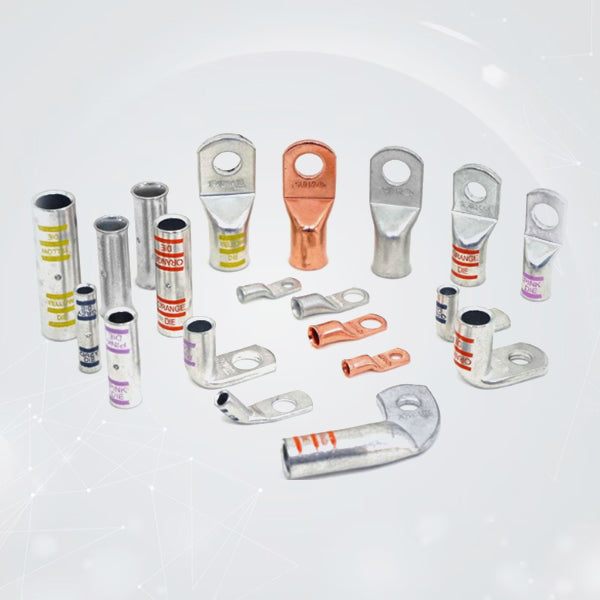


Understanding Copper Battery Lugs: Features That Improve Electrical Efficiency
Copper battery lugs make the vital connection between heavy power cables and battery terminals. Good ones carry high current with almost no voltage loss. Poor ones create resistance, waste power as heat, and shorten system life. Copper battery lugs designed for efficiency have specific features that maximize performance.
Heavy-duty battery lugs and heavy duty wire lugs handle tough jobs like inverters, winches, and marine setups. Battery copper lugs combine excellent conductivity with mechanical strength. These features help you choose lugs that actually improve electrical systems.
Pure Copper Gives Best Conductivity
Copper conducts electricity better than any practical metal. Copper battery lugs use 99.9% pure copper. This achieves 100% IACS conductivity rating.
Pure copper provides three key benefits:
- It generates less heat from electrical resistance.
- More current reaches equipment instead of becoming waste heat.
- Voltage stays stable even under heavy loads.
For example, a 200-amp inverter feed with pure copper lugs loses only 0.1 volt. Lugs made from alloys lose 0.3 volt. That extra 0.2 volt equals 40 watts wasted on a 12-volt system.
Seamless Barrels Create Strong Connections
Heavy duty battery lugs have seamless barrels made from one piece of copper. Welded seams create weak spots where moisture collects.
Seamless barrels offer clear advantages:
- Uniform thickness prevents thin spots.
- Perfect roundness holds crimps securely.
- No gaps where cable strands lose contact.
- Vibration cannot loosen the connection.
A proper crimp creates a smooth hexagonal shape. The barrel shrinks 20-25% in diameter. The cable resists a firm hand pull.
Exact Barrel Size Matches Each Cable Type
Cables marked the same gauge crimp differently based on construction. Heavy duty wire lugs fit specific cable types.
Cable construction determines barrel size:
- Welding cable uses many fine strands and needs smaller barrels.
- Battery cable uses 19-41 strands and fits standard barrels.
- THHN cable uses 7 strands or solid wire and needs larger barrels.
The cable should fill 95% of the barrel space. Loose fits leave air gaps. Tight fits cut strands. Both problems double electrical resistance.
Thick Palms Resist High Tightening Force
Battery posts require 200-300 inch-pounds of torque. Thin palms bend or crack under this force.
Heavy duty battery lugs meet these palm requirements:
- At least 0.12 inches thick.
- Wide surface area over 1 inch in diameter.
- Reinforced area where barrel meets palm.
- No bending after repeated torquing.
This design spreads current evenly across the entire stud. No arcing occurs. Current flows smoothly instead of concentrating at edges.
Chamfered Entry Protects Cable Strands
Sharp barrel edges slice fine strands during insertion. Battery copper lugs include a 15-20 degree chamfered entry.
This chamfer provides important benefits:
- Strands slide into the barrel smoothly.
- No broken wires appear at the crimp mouth.
- The full cable cross-section remains intact.
- Rated current capacity stays unchanged.
Welding cable with over 1,000 strands benefits most from chamfered entries. Without them, installers lose 10-15% of strands.
Correct Stud Holes Prevent Arcing
Lug holes must match terminal studs precisely. Copper battery lugs provide exact sizes for common applications.
Standard sizes include:
- 3/8 inch for most battery posts.
- 5/16 inch for inverters and controllers.
- 1/4 inch for bus bars.
- 1/2 inch for main service connections.
A perfect fit shows these characteristics:
- Lug palm sits completely flat against the terminal.
- No side movement occurs.
- Nut threads engage 6-8 full turns.
- Lug withstands 300 inch-pounds without spinning.
Heavy Walls Fight Vibration Damage
Marine, RV, and engine installations vibrate constantly. Thin barrel walls collapse over time.
Heavy duty wire lugs meet minimum thickness standards:
- 0.06 inches for 4 AWG barrels.
- 0.10 inches for 1/0 AWG barrels.
- Seamless construction eliminates welds.
These lugs pass 1,000 hours of 10G vibration testing. Resistance increases less than 5%.
Clear Markings Avoid Installation Errors
Quality heavy duty battery lugs stamp important details directly on the metal:
- Wire size such as 4 AWG or 2/0 AWG.
- Stud size such as 3/8 inch or 5/16 inch.
- Manufacturer part number.
- UL listing symbol.
Clear markings eliminate guesswork. Installers make exact matches every time. Inspectors approve connections immediately.
Large Size Dissipates Connection Heat
Copper battery lugs absorb heat from electrical resistance and radiate it away.
At 150 amps continuous current:
- Pure copper lug reaches 45°C surface temperature.
- Poor quality lug exceeds 75°C surface temperature.
Cooler operation protects nearby components:
- Cable insulation stays intact.
- Battery terminal posts avoid damage.
- Plastic housings remain undamaged.
Cable and Lug Matching Guide
| Application | Cable Size | Lug Stud Size | Maximum Amps |
| RV House Bank | 4-6 AWG | 5/16 inch | 80-100 amps |
| Marine Starting | 2 AWG | 3/8 inch | 150 amps |
| Inverter Feed | 1/0-2/0 AWG | 3/8-1/2 inch | 200-300 amps |
| Winch Circuit | 2 AWG | Vibration-resistant | 150 amps peak |
| Solar Controller | 4 AWG | Clear markings | 80 amps |
Proper Crimping Locks in Efficiency
Heavy duty wire lugs require matched compression tools.
Recommended crimping process:
- Select hex or indent die for exact wire size.
- Complete full ratchet cycle without interruption.
- Apply single compression at barrel center.
- Confirm smooth barrel profile after crimping.
Verification steps confirm success:
- Cable resists firm hand pull.
- Barrel shows clean hexagonal shape.
- Resistance measures under 0.1 milliohm.
- Temperature rise stays below 40°C at rated load.
Complete Installation Process
Follow these steps in order:
- Choose lug matching wire gauge and stud size.
- Cut cable squarely without crushing strands.
- Strip exactly 3/4 inch of insulation.
- Insert cable until insulation touches barrel end.
- Crimp using matched die and full pressure.
- Apply 3:1 adhesive-lined heat shrink tubing.
- Clean terminal surface with wire brush.
- Tighten to exact manufacturer torque specification.
Expected Performance Over Time
Quality copper battery lugs maintain stable operation:
- Year 1: 0.04 milliohm resistance.
- Year 5: 0.045 milliohm resistance.
- Year 10: 0.05 milliohm resistance.
Poor quality lugs degrade rapidly:
- Year 1: 0.08 milliohm resistance.
- Year 2: 0.15 milliohm resistance.
- Year 3: Complete failure.
Real Cost Comparison
Initial costs:
- Standard lug: $1.50 each.
- Copper battery lug: $2-4 each.
- Quality crimping tool: $100.
Protection value:
- Batteries worth $1,000 or more.
- Inverters worth $800 or more.
- Cable replacement at $200 per meter.
Quality lugs pay for themselves by preventing the first failure.
Key Takeaways
Copper battery lugs improve efficiency through careful design. Pure copper provides maximum conductivity. Seamless barrels ensure strong crimps. Precise sizing eliminates resistance. Thick construction resists vibration.
Heavy duty battery lugs endure tough conditions. Heavy duty wire lugs maintain performance. Battery copper lugs deliver reliable power.
Essential features include:
- Pure copper rated at 100% IACS conductivity.
- Seamless barrels for gas-tight crimps.
- Exact sizing to eliminate air gaps.
- Thick walls that resist vibration.
- Clear markings for error-free installation.